The Lead
The NFL stopped selling and started buying
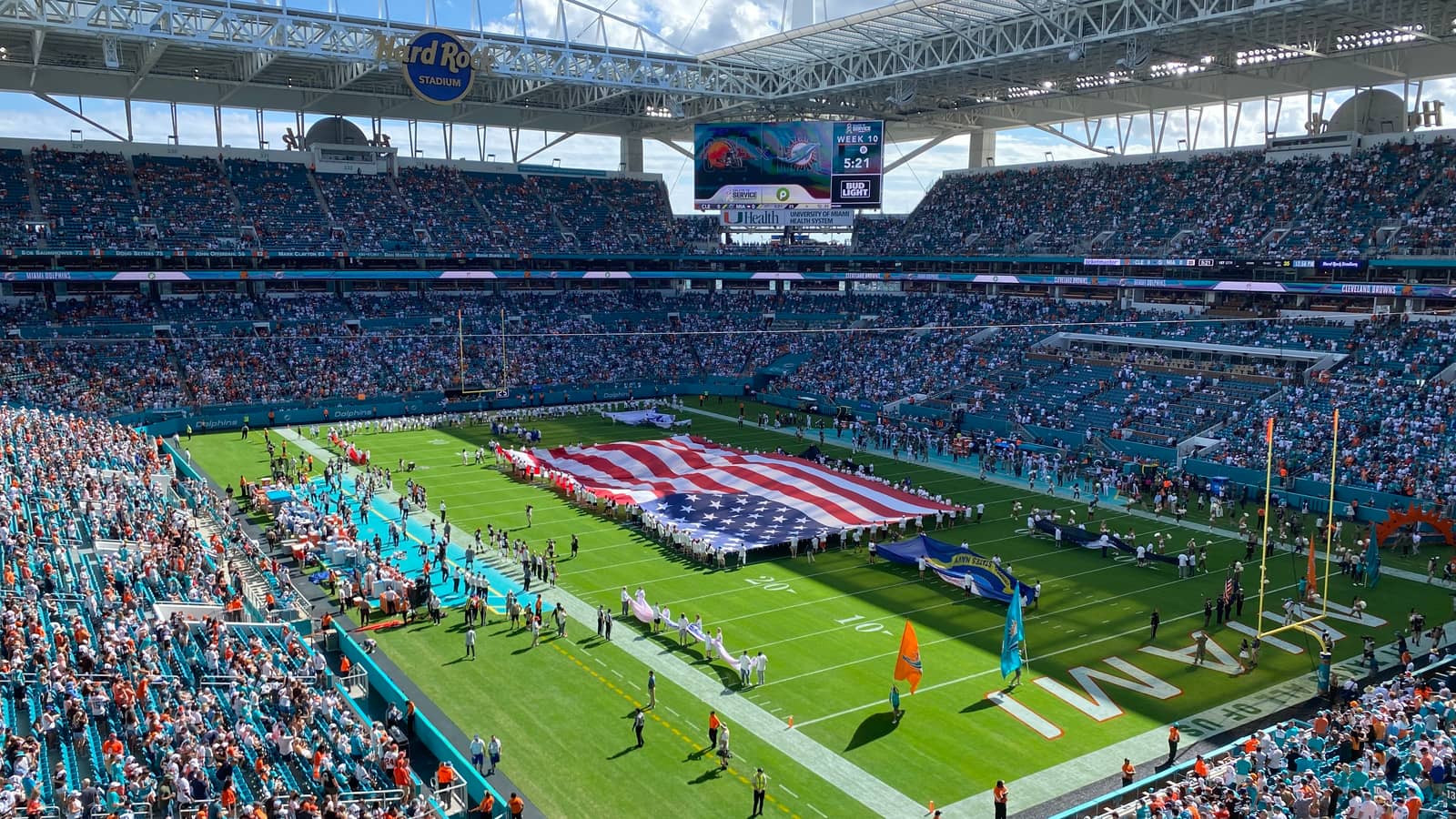
Three things happened at the Oct 20 owners meeting in New York, and they're one story. In 2024 the league was still debating whether to let private equity in at all. Now it's built its own deal machine.
The vote nobody wrote up properly. Owners approved a global partnership between 32 Equity, the NFL's investment arm, and General Atlantic, the $100B-plus growth investor. The release says the venture will back "companies building technologies, platforms, and experiences" in sports. It doesn't say how much money, who decides where it goes, or what GA gets out of it. PJT advised. Owners had already put $256M of their own money into 32 Equity by late 2022, per Front Office Sports, on top of exits like On Location and a reported $320M stake in Fanatics. General Atlantic's balance sheet is a different order of magnitude.
What the press release left out: 32 Equity already owns pieces of the vendors its teams buy from. Add a GA checkbook and the league can invest in a ticketing, data or media company, then point 32 clubs' spending at it. That looks more like a sovereign wealth fund than a venture fund. So if you sell into the NFL, ask yourself whether you want the league on your cap table before you want it as a customer.
Deal · Oct 20
Arctos Partners → Atlanta Falcons
- Stake
- 7.5%
- Price
- ~$795M
- Valuation
- $10.6B
+2.5% more pending a later vote · Arctos's 4th NFL team
The fourth team. The same meeting approved Arctos buying 7.5% of the Falcons, with another 2.5% lined up for a later vote. CNBC reported the full 10% at a $10.6B valuation back in August, which puts this slice at about $795M. That's four NFL teams for Arctos now (Bills, Browns, Chargers, Falcons), and it's the only firm cleared to hold stakes in multiple teams across all five major U.S. leagues. A firm sitting in four teams' budget meetings sees numbers no single owner does, and the league's rules weren't written with that in mind.
Deal · Oct 16
Stephen Ross → Jean Eric Salata · Miami Dolphins
- Stake
- 2.1%
- Price
- ~$262M
- Valuation
- $12.5B
+54% vs. $8.1B in Dec 2024 · same mark as March
The mark. Stephen Ross sold 2.1% of the Dolphins to EQT chairman Jean Eric Salata at a $12.5B valuation, about $262M. That price also covers Hard Rock Stadium, the Miami Grand Prix and the Miami Open stake, so it's not a clean franchise number. Still: Ares and Joe Tsai bought in at $8.1B in December 2024, and Xiaomi co-founder Lin Bin paid about $125M for 1% at $12.5B in March. So the 54% mark-up took 15 months, and seven months later the chairman of a €267B private-equity firm, who didn't need the NFL's help pricing it, paid the same number. The finance committee cleared the sale in September, and owner ratification was on the same meeting's agenda.
Why it matters to your money. Sophisticated buyers are now paying above the Forbes list for limited-partner (LP) stakes in NFL teams. The league is investing right next to the funds buying those stakes, and the funds are stacking positions across teams. If you represent players, the salary cap is now the only line in the NFL economy that isn't compounding at private-market rates. If you advise athlete investors, the LP window in NFL teams is closing from the top down. The next way in is the vendor layer 32 Equity is about to start buying.
Deal Sheet
| What happened | The number | One line |
|---|---|---|
| MSG Sports splits the Knicks and Rangers into two listed companies; the spin closed Oct 26, and MSGK and MSGR started trading separately Oct 27 | 1 MSGR share per 2 MSGS; the Rangers leave with $16.5M of NHL advance debt and an undrawn $250M revolver; Dolan chairs both | For a decade you could buy the Knicks at a discount to Forbes. The spin is Dolan trying to close that gap without selling. |
| Netflix reports Q3 and cuts ~1,000 jobs, including the content chief who ran its NFL talks | $12.87B revenue, +12%; net income $3.67B, +44%; shares down 44% over 12 months | The NFL package grew to five games this year, and the exec who negotiated it is gone. Rights holders: expect a tougher second round. |
| Utah sues Kalshi in state court as a public nuisance and illegal gambling operation, then files criminal charges against Kalshi and its two co-founders; the CFTC has sued Utah to stop it | $30.6M to $61.2M in fees collected on Utah wagers, plus at least $5.5M in profits through May, per the complaint; 14 criminal counts | Kalshi already lost its emergency injunction at the 10th Circuit on Sept 8. Utah put a dollar figure on the fees, then went after the founders personally. Kalshi calls the charges "a crazy overreach." With a federal agency suing a state, this is now a fight over who regulates prediction markets at all. |
| Stifel finds prediction-market growth slowing against sportsbooks | Taker-only volume +27% in September vs. regulated handle +43%; Kalshi share down to 79% from 86% | First independent sign the prediction-market curve is bending. DraftKings reports Nov 5. |
| WSJ: FIFA's prediction-market partner ran $108M of its $167M volume through accounts trading with each other | 795 wallets = 99% of volume; paid FIFA $150M+ for World Cup ad rights | FIFA took $150M from a platform that was mostly trading with itself. Whoever diligenced that deal didn't look at the chain. |
| Truist and BofA cut DraftKings Q3 EBITDA estimates | Truist: Q3 loss of $67M, FY to $598M from $686M; BofA: Q3 loss of $100M | Both blame prediction-market spend. Flutter said Nov 4 it expects to lose about $200M on prediction markets this year and to invest at similar or higher levels in 2027. The sportsbooks are paying to defend a market regulators might shut down for them anyway. |
| Rezzil raises $10M with the Premier League, Simba Investments and Jobe Bellingham; opens Chicago office | $10M | VR movement-tracking for football, licensed by the Premier League since 2024. Ex-Hawk-Eye and NBA exec Jake Loos runs North America; the targets are college programs now spending revenue-share money on performance tech. |
Tech Desk
What the NBA means by "AI officiating"
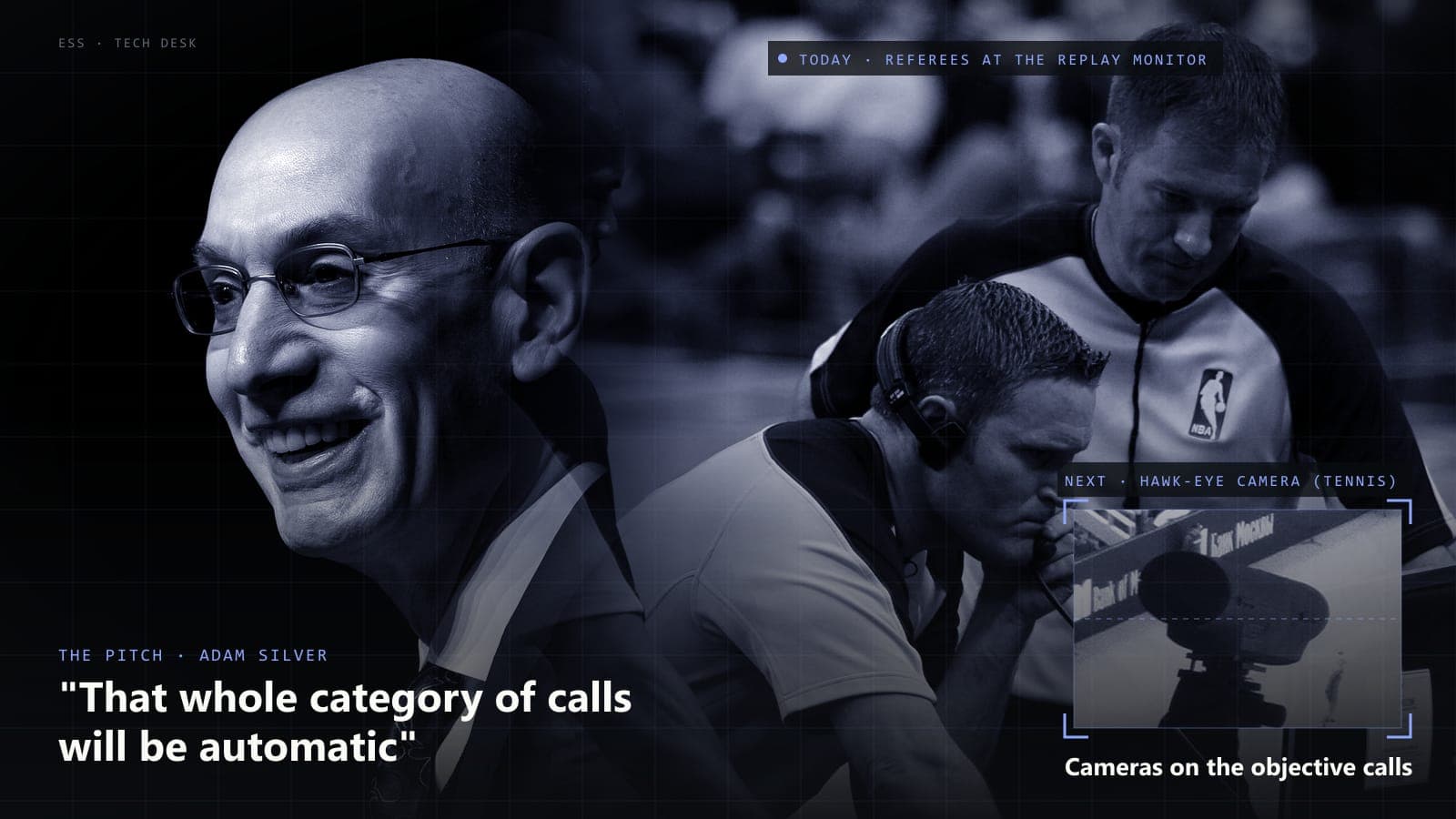
The NBA season opened Oct 20, and Adam Silver spent all of October telling anyone with a mic that the league is going to automate calls. Some of it is in testing, some of it is a demo, and a few companies stand to get paid either way.
Real: the smart ball. Wilson put a roughly one-gram chip inside the 620-gram game ball. It's been tested in the G League and Summer League, and in blind A/B tests players couldn't tell the difference. Silver told CNBC it could be in games "as soon as next year". The chip's job is narrow: did a finger touch the ball before it went out, did the arc change on a goaltend. That's a sensor, not AI.
Real, but not yet: camera-based objective calls. Silver said in May the league will "move to a system where that whole category of calls will be automatic," meaning out-of-bounds and other objective rulings made by cameras around the court. His model is Hawk-Eye in MLB's ABS challenge system. No NBA vendor named, no timeline, and contact calls stay with humans.
A demo: referee wearables. Refs tested wrist devices in preseason to speed up contact with the replay center and fix clock errors. They won't be used this regular season.
The fight that matters: data. The NBA and NBPA have no deal on how wearable or tracking data gets collected or used. In Silver's own words, the union is worried the data "could get used in bargaining." It should be. Any system that tracks a player closely enough to call a foul tracks him closely enough to argue he's declining in a contract negotiation. So the officiating fight is mostly a fight over who owns player data.
Who gets paid. Wilson, for the ball. Whoever wins the court-camera contract (Hawk-Eye, owned by Sony, is the obvious bidder; Second Spectrum, which Genius Sports bought for $200M in 2021, already runs the NBA's tracking). And the lawyers on both sides of the data clause in the next CBA.
The Builder
Rezzil, and the league that owns a piece of it

Raise · Oct 19
Rezzil · Manchester, now Chicago and London
- Raised
- $10M
- Staff
- ~50 → 100
- PL stake since
- 2024
Backers: Premier League, Simba Investments, Jobe Bellingham
What it sells. Rezzil started in Manchester as VR training software: a club loads Premier League match data into a headset and replays real match situations. Now it sells what it calls "Movement Intelligence," the same player-and-ball tracking turned into performance analysis, broadcast graphics and games. The BBC's Match of the Day uses its 3D tools to rebuild plays on air, per Inside World Football.
Who runs it. CEO Sion Colley and CFO Paul Mann ran Angstrom Sports, the betting-data firm Entain bought in 2023. Jake Loos, ex-Hawk-Eye and NBA, runs North America from a new Chicago office. The cap table reads like a dressing room: Thierry Henry, Vincent Kompany, Cesc Fàbregas and, in the $10M round announced Oct 19, Jobe Bellingham.
Who pays. The release doesn't say. Clubs, broadcasters and gamers are three different buyers at three different price points, and this round is funding all three plus a mobile-games push. That's the number we'd want to see.
Why it's here. The Premier League took equity in Rezzil in March 2024 alongside a four-year licence to build on its match data. License your data to a company you own a piece of and you get paid twice. That's the 32 Equity model two years early, and a good reason to expect an NFL version.
The Front Office
The cap is the only thing in the NFL that isn't compounding
Arctos is now in four NFL ownership groups. Ross has marked the Dolphins up 54% since December 2024. The league built a fund with General Atlantic to buy the companies its own teams pay. Every balance sheet in the building is growing at private-equity rates except one: the player share, locked to a percentage of a revenue definition negotiated in 2020. In the next CBA, the percentage matters less than the definition: whether franchise appreciation, LP stake premiums and the league's own investment returns count as revenue at all. Right now they don't, and the players are the only partners in this business who can't buy in.
By the Numbers
54%. The Dolphins' mark-up from the Ares/Tsai entry at $8.1B (Dec 2024) to $12.5B. Lin Bin bought at that mark in March 2026, and Salata did again in October. We ran it in the ESS Deal Ledger off the reported valuations.
$795M. What 7.5% of the Falcons costs at the $10.6B valuation Arctos agreed to in August. For scale, that's more than the whole franchise sold for in 2002 ($545M).
99%. Share of FIFA's prediction-market partner's volume that came from 795 wallets, per the WSJ. The platform paid FIFA more than $150M. A sponsor's volume isn't revenue, and the next league that signs a prediction-market deal should ask for the wallet count.
Calls
Three calls this issue, each with a deadline and how sure we are. We'll keep score on the site, misses included.
- 01
Arctos's remaining 2.5% of the Falcons is approved at or above the $10.6B valuation
Likely · Open · Resolves by Mar 31, 2027
- 02
At least one more NFL limited-partner stake is reported above a $12.5B valuation
Lean · Open · Resolves by Jun 30, 2027
- 03
Utah and Kalshi announce a settlement or consent order by April 30, 2027
Long shot · Open · Resolves by Apr 30, 2027
Record: 0 right · 0 wrong · 3 open